.png)

Most small companies try to beat their larger competitors by looking bigger than they are. Slicker decks. More polished proposals. A sales process that mimics the enterprise cadence of the incumbent. It almost never works. When you compete on the giant's terms, you lose on the giant's terms.
I've spent seven years at PheedLoop, the third employee through the door, now running revenue. Our biggest competitor is a publicly traded US event-tech incumbent roughly a thousand times our size. We don't win every deal against them. We don't even win most. But we win enough that I've stopped treating it as an accident and started treating it as a strategy.
Here's the strategy, as plainly as I can put it: being small isn't a disadvantage you apologize for. It's the only thing the incumbent cannot copy. They cannot get smaller. They cannot move faster. They cannot care more about a single deal. Those doors are closed to them by the shape of their business. Every one of those doors is open to you.
What follows is the framework I teach to founders and operators who are tired of losing on the giant's terms. Three moves. Not clever. Just things most companies don't actually do.
If you're reading this as an event planner or a program owner inside a larger organization, the framework still applies: the "giant" in your world might be a parent procurement team, a legacy vendor relationship, or an internal department that out-resources yours. The shape of the fight is the same.
Move One: Speed
Not speed in the Silicon Valley "move fast and break things" sense. That phrase is mostly a lie. I mean speed in the literal sense: the client emailed us at 4 PM and we replied at 4:04. The prospect asked about a custom feature and we built a working mockup before they'd signed anything.

Here's what this actually costs you: you cannot have a sales process with eleven stages. You cannot have a product roadmap that's locked by committee for the next quarter. You cannot have an approval chain that routes through a VP in another time zone.
Incumbents have all three of those things. They have them because at their scale, they need them. Unlock-any-of-them and the whole operation breaks. But that's their constraint, not yours. The mistake small companies make is copying the incumbent's process in the hope it makes them look credible. It doesn't. It makes them slower without the compensating scale.
Speed as a deliberate strategy means structuring your company to make instant responses possible. One person can approve a proposal. One person can greenlight a custom feature. One person can decide to spend money on something before it's technically justified. If three signatures are required for any of those things, you've already lost the speed advantage. Fix the signatures.
Move Two: Identity, On Purpose
For us, the relevant identity is Canadian. For you it might be something else: your city, your industry specialization, your technical pedigree, the specific customer segment you grew up serving. Whatever it is, it has to do actual work. It can't just be a flag on your website.
I used to think "we're Canadian" was marketing fluff. It isn't. When we're pitching against the US incumbent to a Canadian association, a Canadian university, or a Canadian non-profit, the "we're from Toronto" line changes the conversation. Not because our clients are flag-waving nationalists. Because they've been burned.
Burned by account managers in Texas who don't know what Canada Day is. Burned by support teams that don't understand bilingual requirements. Burned by contracts that don't handle PIPEDA. Burned by USD pricing that made their procurement person cry. "Canadian" isn't a brand value. It's a list of specific headaches we save them, and the list is the sales pitch.
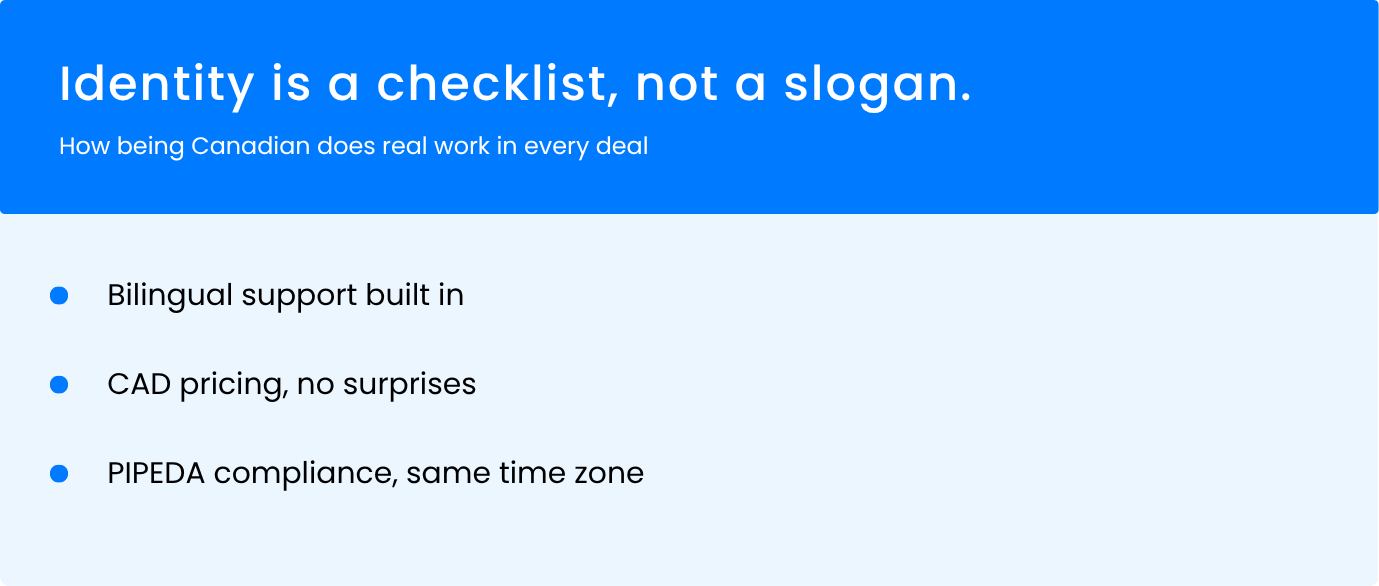
The mistake I see founders make with identity is treating it as marketing copy: "family-owned," "founder-led," "boutique." Those words don't save anyone a headache. If you can't turn your identity into a list of specific pains you eliminate for specific customers, you don't have an identity strategy. You have a tagline.
Move Three: Pick Your Fight
This is the move that's hardest to commit to. You cannot beat a giant at everything. If you try, you will lose, and you'll lose while also exhausting your team trying to match feature lists you'll never catch.
What you can do is pick the two or three things you're going to be obsessively, uncomfortably, visibly better at. And then be honest with every prospect about the things you're not.
I'll tell you ours. We're better than the incumbent at onboarding speed, at product responsiveness, and at human support. We're not better at enterprise procurement workflows. We're not better at producing the 80-page response documents some procurement teams require. When a prospect tells me they need those things, I tell them to go buy the other guys.
You would be surprised how often that conversation ends with them buying us anyway.
The reason is that nobody else in their procurement process is telling them the truth. Every other vendor is saying "yes, we do that, and everything else, and more." When one vendor says "no, we don't, and here's who you should call if that matters most," it's disorienting, and it reads as confidence. Which it is. You can only tell a prospect to buy the competitor if you genuinely believe they'll come back, and prospects can feel the difference between a vendor playing a long game and one panicking to close a quarter.
Picking your fight also simplifies everything else. You stop spending roadmap hours on features meant to check a procurement box. You stop letting sales promise capabilities engineering has to scramble to build. You stop being a worse version of the incumbent and start being a better version of yourself.
The Deal I Almost Didn't Close
A year ago we were in a competitive bid against the incumbent for a six-figure USD deal with a state-level association. Their team was going through the standard process: multiple vendors, multiple rounds, proposal decks, reference calls.
At some point I made a call that, depending on how the next few weeks went, was either going to look smart or look stupid. I booked a flight and showed up at their office. In person. To demo our product across a table from them.
I want to be honest about this part, because I've watched founders tell stories like this on stages and leave out the uncomfortable bit.
The uncomfortable bit is that I didn't know we were going to win. I spent real money on the flight and a week of my time. And before they'd signed anything, our engineering team had built custom mockups of a feature their specific workflow needed. Real development hours, pre-commitment.
If they'd picked the other vendor, all of it was a loss. Not a rhetorical loss. A literal one on our books.

We do this more than once a year, and we don't win every time. So if you're reading this thinking "that sounds great but that's a big bet for a small company," you're right. It is. We've decided to keep making the bet because the alternative, which is trying to out-deck a vendor that produces glossy procurement materials in its sleep, is a bet we would lose every single time.
They went with us. And when I asked them why, months later, the answer wasn't about the product. It wasn't about the price. It was that nobody from the other side had gotten on a plane.
Your Job Is Not to Look Bigger
Here's what I've come to believe after seven years of this: most of the time, the giant isn't actually better. They just look like the safer choice. And the safer choice wins by default unless somebody gives the client a specific reason to pick differently.
The plane was a reason. The 4:04 reply is a reason. The honest "we're not the right fit for that, go buy the other guys" is a reason.
Reasons are free. You just have to decide to give them.
The playbook the giants wrote is not the playbook you're supposed to run. They wrote it for a company that has a thousand times your resources and a hundred times your headcount. Running their playbook with your resources is how small companies die. Running your own playbook, written for the size and shape of the company you actually are, is how you win deals you have no business winning.
Being small is a feature. Use it.

Mitch is VP of Revenue at PheedLoop, a Toronto-based event technology company. He's been with PheedLoop for seven years and was the third employee through the door. Reach him at mitch@pheedloop.com.
.png)

.png)
.png)
.png)